An unsolicited call offering a free super review can start with a comparison between the consumer’s existing fund and a portfolio with much higher past returns. The comparison may leave out differences in risk, fees and the period measured.
In Report 845, published on 9 November 2026, ASIC examined scripts and recordings used by businesses that referred people to advisers after an ad, online form or telephone call.
The report is aimed at financial advice licensees. But it reads like a field guide for the rest of us. It shows how your details are bought, what the caller says, who gets paid and how quickly people are asked to sign.
ASIC says approximately 12,000 investors lost more than $1 billion in the Shield and First Guardian collapses and that many were first approached by a lead generator. ASIC’s inclusion of a licensee in its review did not establish involvement in either collapse or a finding of misconduct.
Key Takeaways
- ASIC reviewed 15 advice licensees with links to lead generation, covering January 2025 to June 2026. Lead generators referred 7,639 new clients, about 35% of all their new clients.
- More than $678M was switched or invested after a referral, and about 90% of it came from super.
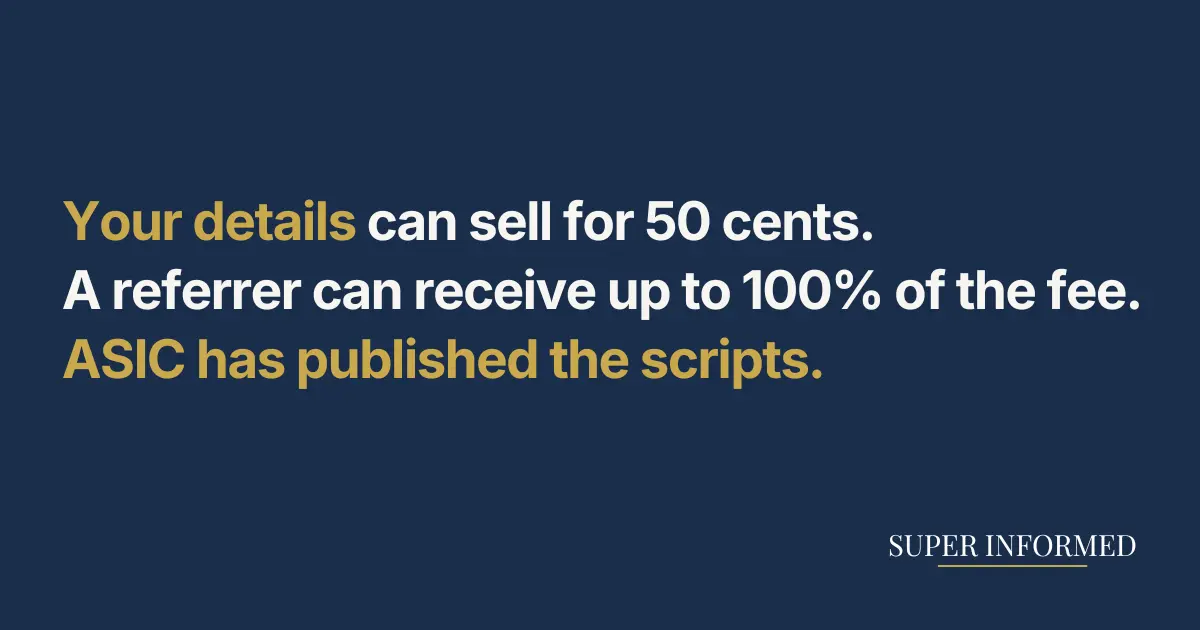
- ASIC found data brokers charging between $0.50 and $75 per lead.
- Some licensees paid referral partners 80% to 100% of the client’s upfront advice fee, and that fee was deducted from the client’s super.
- More than half of the licensees let lead generators carry out core advice tasks such as fact-finding, risk profiling or discussing recommendations. One licensee’s scripts named the platforms that would be recommended.
- Only 2 of the 15 licensees banned clients from signing on the same day the advice was presented.
- ASIC has called it a “final warning” to licensees and published a list of known lead generation entities on Moneysmart.
- Moneysmart recommends checking unsolicited approaches independently and using ASIC’s Financial Advisers Register to verify an adviser’s authorisation.
The report in 60 seconds
| Finding | Figure |
|---|---|
| Licensees reviewed | 15 |
| Review period | 1 January 2025 to 1 June 2026 |
| New clients referred by lead generators | 7,639 (about 35% of all new clients) |
| Money switched or invested after a referral | More than $678M |
| Share of that money from super | About 90% |
| Upfront advice fees | $9.8M |
| Ongoing advice fees committed | $4.5M a year |
| Licensees getting 60% to 100% of new clients this way | 7 |
| Price of a lead | $0.50 to $75 |
| Licensees that banned same-day signing | 2 |
Source: ASIC Report 845 and media release 26-270MR.
Contents
- How do your details end up on a lead list?
- What happens on a “free super review” call?
- Who is actually giving the advice?
- Referral payments and advice fees
- Why does this matter if you run an SMSF?
- What are the red flags of a lead generation call?
- How can you check who you’re dealing with?
- ASIC enforcement and proposed reforms
- What trustees should consider
- Frequently Asked Questions
How do your details end up on a lead list?
It can start with something harmless. You click an ad, fill in a form on a comparison site, do an online quiz, or ask a website to find your lost super.
Moneysmart says handing over your details in ways like these can put you on a lead generation list. The point of the list is to connect you with a business that may sell you something.
Those details can then be sold. ASIC found data brokers charging between $0.50 and $75 per lead, depending on how “qualified” and exclusive the lead is. A referral partner may then obtain the lead and make the call.
What happens on a “free super review” call?
The caller may not be a licensed adviser at all. ASIC obtained scripts and call recordings and found several recurring techniques.
| Technique | What ASIC found | Why it may mislead |
|---|---|---|
| The return comparison | A caller claimed a person’s Balanced option had returned 4.93% a year over 5 years, then pointed to 13.8% from a different firm’s growth portfolio | The two options weren’t built to take the same level of risk, so the comparison isn’t like for like |
| The fear | A caller said the person’s fund had only 10 to 15 investment options, so a crash could wipe out a big chunk of their super | The number of options on a menu says little about diversification. A single option in a large fund can hold thousands of underlying investments |
| The story about someone like you | A script described a client in a similar situation whose returns went from 7% to 10%, now on track for an extra $115k or $225k at retirement | The script left room for either number, which tells you how specific it really was |
ASIC’s concern is that statements like these may compare things that aren’t like for like, use cherry-picked performance, make misleading claims about fees and features, and use fear of a market crash to push a switch. And some were made by people with no licence to influence a financial decision at all.
Who is actually giving the advice?
More than half of the licensees ASIC reviewed let lead generators do at least one core advice task: fact-finding, risk profiling, or discussing the advice recommendations with the client. In some cases, lead generators handed over the Statement of Advice itself, the document setting out the adviser’s recommendations, and collected the client’s signed authority to proceed.
At one licensee, the lead generators’ call scripts named the super platforms that would be recommended. The script named a platform before the adviser’s personal advice was presented.
The report also cites a tribunal decision confirming that an adviser remains responsible for collecting the information needed to give personal advice.
Then comes the signature:
- Where licensees monitored timing, they reported providing statements of advice between 48 hours and 20 days after the fact-find.
- Authorities to proceed were sometimes signed the same day the advice was presented.
- Only 2 of the 15 licensees banned same-day signing, and 5 had no policy on it at all.
And if something went wrong later, the evidence may be gone. Only a small number of licensees had reliable access to call recordings, and most recordings were deleted after 90 days.
Referral payments and advice fees
The report describes how some businesses paid referral partners when a client signed up.
A referral business could receive most or all of the upfront fee. Some licensees paid referral partners 80% to 100% of the client’s upfront advice fee, often only if the client signed up. That fee was deducted from the client’s super. So the person on the phone may be paid from your retirement savings for convincing you to switch.
The fees add up. Across the 7,639 clients:
| Total | Simple average per client | |
|---|---|---|
| Upfront advice fees | $9.8M | about $1,280 |
| Ongoing advice fees | $4.5M a year | about $590 a year |
| Money switched or invested | $678M | about $89k |
Averages are our calculation from ASIC’s totals. Individual fees vary.
Why the model keeps going. ASIC notes that even after passing most of the upfront fee to the lead generator, an advice business can still profit from volume: lots of new clients, ongoing fees, and money directed into particular products. Some of the businesses reviewed didn’t cap how many clients an adviser could take on.
In its media release, ASIC said licensees could put their authorisations at risk if they allow lead generation arrangements that expose consumers to harm.
Get the weekly SMSF update from Super Informed.
Why does this matter if you run an SMSF?
To be clear, this report is mostly about people being moved from their existing super fund into investment platforms, not about SMSFs. But it matters to trustees for 3 reasons.
1. Similar tactics appear in rollover scams. The cold-call and “set up your own fund” scams we’ve covered in our rollover scam article can follow a similar pattern: an ad, a call, a sense of urgency and a quick signature. It’s one reason the government’s August 2026 reform package proposed giving the ATO power to stop rollovers into newly established SMSFs in cases such as suspected fraud or financial abuse.
2. The approach can reach family members. Someone who responds to an ad or enquiry about super consolidation or a retirement review can be contacted by a third party.
3. A separate super account can be affected. A person who runs an SMSF and also holds an account in a retail or industry fund could be approached about switching that account.
What are the red flags of a lead generation call?
Not every ad is a problem. ASIC says it generally has no concern with conventional advertising and marketing that isn’t misleading. The warning signs are in what happens next.
| Red flag | Why it matters |
|---|---|
| An unsolicited “free” or “complimentary” super review | Moneysmart lists free “super health checks” among its warning signs |
| Big return promises, especially 10% or more | Often compared against your current option without matching the risk |
| Fear of a crash used as the reason to move | ASIC flagged fear-based messaging as potentially misleading |
| ”Someone just like you” stories with a dollar figure | Scripted, not based on your circumstances |
| A caller who can’t name the adviser and their licensee | The person discussing your risk profile and recommendations may not be licensed |
| A recommendation that seems settled before you’ve explained your situation | In one case, the platform was named in the script |
| Pressure to sign quickly, including the same day | Only 2 of 15 licensees banned same-day signing |
Moneysmart’s own advice for unsolicited contact about your super is 3 words: Stop. Check. Protect.
How can you check who you’re dealing with?
Two free checks take a couple of minutes.
ASIC’s Financial Advisers Register. The register on Moneysmart lists people who provide personal advice on investments, super and life insurance. You can search by name, number, ABN, suburb or postcode, and see who licenses them, their qualifications and the products they can advise on.
ASIC’s list of known lead generation entities. Also on Moneysmart, ASIC publishes a list of entities involved in lead generation, referral partners, and the advice licensees or authorised representatives that acquired leads since 1 July 2024. Being on the list isn’t a finding of wrongdoing, and the list isn’t exhaustive, but it’s useful to know who you’re dealing with.
ASIC enforcement and proposed reforms
ASIC says licensees that enable or ignore this conduct may put their licence at risk. According to the report, it has also:
- contacted professional indemnity insurers about these business models
- published the list of known lead generation entities, which super fund trustees are now checking against their own data
- flagged ongoing enforcement matters involving licensees, advisers and lead generators
The government’s reform package, announced on 19 August 2026, proposes restrictions on unlicensed parties contacting people about super in real time, stronger consent and anti-hawking rules, tighter licensee oversight, and consultation on data harvesting and broking.
The SMSF Association backed a targeted restriction on high-risk activity while preserving legitimate referrals. Treasury’s consultation on curbing lead generation outlines policy options.
What trustees should consider
The report gives readers questions to ask about the motivation for a super switch, who made the recommendation and where the fees went.
Questions worth asking yourself, and your family:
- Has anyone contacted you or a family member about a “free” super review this year?
- If you’ve switched or rolled over super after a call, who made the recommendation, and were they on the Financial Advisers Register?
- What fees came out of the account when it happened, and who received them?
- Do you still hold an account in a large fund that could be switched?
- Who in your family would benefit from seeing this?
Frequently Asked Questions
What is lead generation in super?
Lead generation is the business of collecting people’s contact details, often through ads, quizzes or comparison forms, and passing them to businesses that want to sell them something. In super, ASIC found leads were often used to arrange “free super review” calls that ended with clients switching funds.
What did ASIC’s Report 845 find?
ASIC reviewed 15 advice licensees and found lead generators referred 7,639 new clients, with more than $678M switched or invested, about 90% of it from super. It found some lead generators doing core advice tasks, potentially misleading sales scripts, and referral partners paid up to 100% of the upfront advice fee.
Are “free super review” offers a scam?
Not always, but ASIC and Moneysmart list unsolicited free super health checks among the warning signs. Some of the conduct in ASIC’s report involved unlicensed people discussing advice, fear-based messaging and pressure to sign quickly.
How do I check if a financial adviser is licensed?
Search ASIC’s Financial Advisers Register on Moneysmart. It shows whether an adviser is registered, who licenses them, and the products they can advise on.
Who pays the advice fee after a super switch?
In the arrangements ASIC reviewed, the advice fee was generally deducted from the client’s super. Some licensees then paid 80% to 100% of the upfront fee to the referral partner that made the call.
Does this affect SMSF trustees?
The report looked at advice arrangements involving lead generation, including switches from existing super accounts. Similar sales tactics can be used in SMSF-related scams and can affect people who also hold accounts in larger funds.
Disclaimer
This article is general information only and does not constitute financial or legal advice. It does not take into account your objectives, financial situation or needs. It summarises ASIC’s published findings. ASIC has said that inclusion on its list of lead generation entities is not a finding of misconduct, and this article does not suggest wrongdoing by any particular business. Information is current as at 12 November 2026 and may change. Always consult a licensed financial adviser, accountant or SMSF specialist before making decisions about your super.